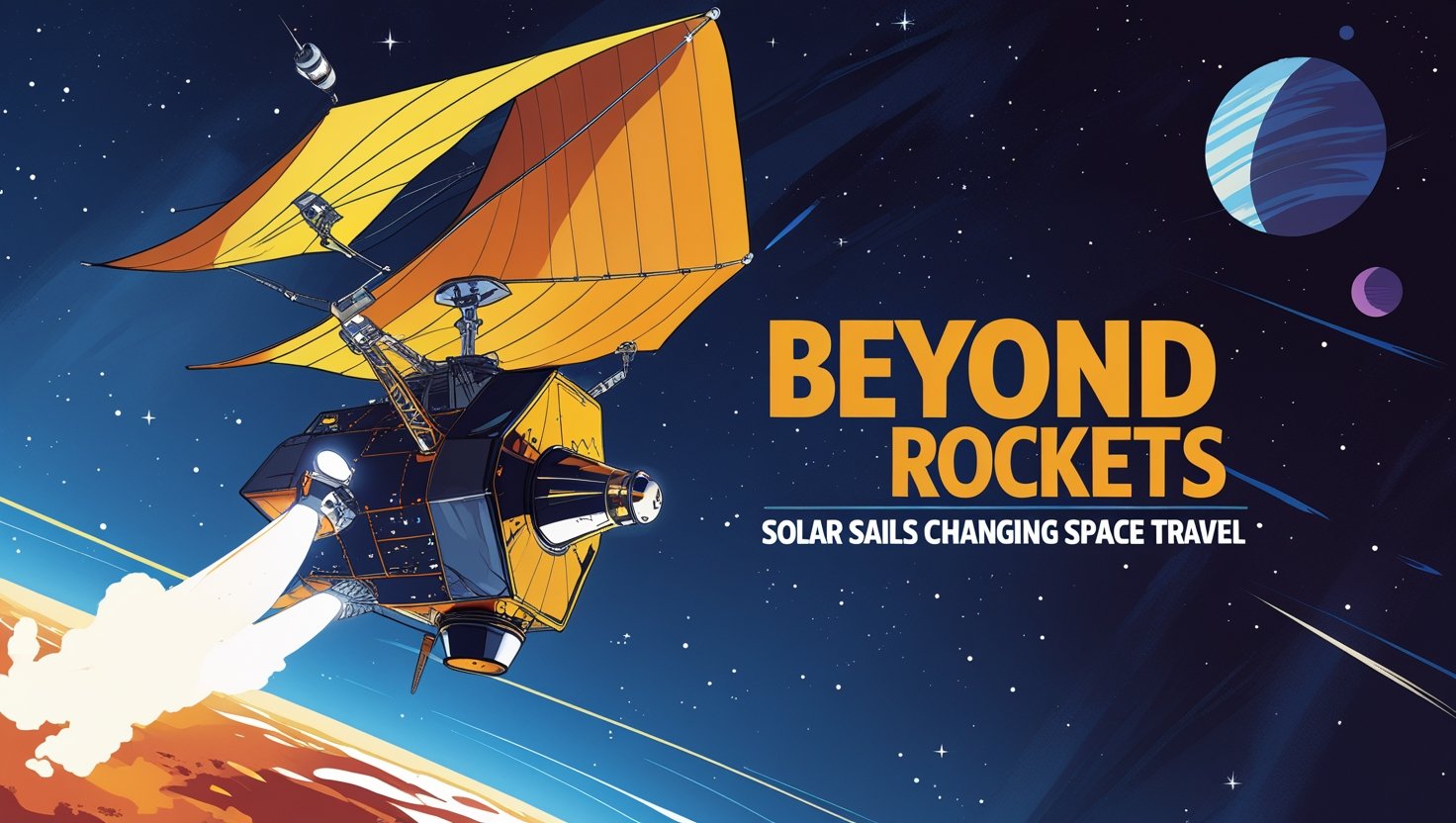
Space travel often brings one image to mind: powerful rockets. These machines, fueled by burning propellants, have been vital since the Space Age began. They blast off with immense force, pushing us toward new frontiers. Yet, a quieter, more efficient way to travel through space is now taking shape. This article introduces solar sails, a technology that could revolutionize our journey beyond Earth.
The Physics of Sunlight: How Solar Sails Work:
This section explains how solar sails use the sun’s power. It breaks down the science in a simple way. You will see how these giant sheets of material gain speed.
Harnessing Photons: The Power of Sunlight Pressure:
Sunlight is made of tiny packets of energy called photons. Each photon carries a small amount of momentum. When a photon hits a solar sail, it bounces off. This bounce transfers its momentum to the sail. It creates a tiny but constant push, much like wind filling a ship’s canvas. This push is known as light pressure.
The strength of this push depends on how far the sail is from the Sun. Light pressure follows the inverse square law. This means as you get farther from the Sun, the light pressure drops quickly. For example, twice the distance means one-fourth the push. Still, this steady force builds up over time, leading to impressive speeds in deep space.
The Sail Material: Lightweight and Reflective:
The key to a good solar sail is its material. It must be incredibly thin, strong, and highly reflective. These properties allow it to catch the maximum amount of light. Early sail designs used materials like Mylar and Kapton. These are common plastics that can be made very thin.
Newer materials are being explored. These include carbon fiber composites and other advanced films. The goal is to make sails even lighter and stronger. A lighter sail needs less force to accelerate. A stronger sail can withstand the harsh conditions of space. These advances make long-duration missions possible.
Continuous Thrust vs. Explosive Force:
Rockets create thrust with powerful, short bursts of energy. They burn a lot of fuel quickly. This gives them a huge push for a short time. Solar sails work very differently. They provide a continuous, low level of thrust. This tiny push happens all the time.
This difference affects how missions are planned. Rockets reach high speeds fast, then coast. Solar sails slowly gain speed over weeks, months, or even years. This continuous acceleration allows them to reach very high velocities. They can travel to destinations far beyond what rockets can reach efficiently. This quiet, steady push is a game-changer for long-haul space travel.
A Brief History of Solar Sail Concepts and Missions:
The idea of solar sailing is not new. Scientists have dreamed about using light for propulsion for centuries. This section traces that journey. We will see how these dreams slowly became reality.
Early Dreams: From Kepler to the Space Age:
The concept of light pressure dates back to Johannes Kepler. In the early 1600s, he noticed that comet tails always point away from the Sun. He correctly guessed that sunlight pushed them. Later, in the early 20th century, scientists like Konstantin Tsiolkovsky and Hermann Oberth talked about “light rockets.” These early thinkers laid the groundwork. They showed that the idea had a scientific basis.
Early Demonstrations: Proving the Concept:
The first small steps to prove solar sailing began decades ago. Researchers conducted tiny experiments in labs. They showed that light pressure could indeed move objects. These initial tests were proof-of-concept missions. They were not for space travel. Rather, they confirmed the basic physics. These early wins were important for gaining wider support.
The Dawn of Practical Sails: IKAROS and Lightsail 1:
Japan’s IKAROS mission marked a big step forward. Launched in 2010, IKAROS was the first spacecraft to use a solar sail for primary propulsion. It showed that deploying a large, thin sail in space was possible. It also proved the sail could be controlled. This mission gave us key data about how solar sails work in real space conditions.
The Planetary Society’s Lightsail program continued this progress. Lightsail 1, launched in 2015, tested sail deployment. Lightsail 2, launched in 2019, successfully raised its orbit using sunlight. These missions showed that even small, privately funded groups could make solar sailing work. They opened doors for many future projects.
Advantages of Solar Sailing for Space Exploration:
Solar sails offer major benefits. They can change how we explore the solar system. Here are some of the main advantages. They make solar sails a good choice for future missions.
Fuel-Free Propulsion: Sustainable and Cost-Effective:
One of the biggest perks of solar sails is that they need no fuel. Rockets carry massive amounts of propellant. This makes them heavy and costly to launch. Solar sails, on the other hand, use sunlight, which is free and limitless in space. This cuts down launch mass drastically. It also removes the ongoing cost of fuel for long missions.
Think about the long-term savings. No fuel means lower mission costs over time. This makes solar sailing a very sustainable option. It allows for longer missions without resupply worries.
Long-Duration, High-Delta-V Missions:
Solar sails provide continuous thrust. This lets them slowly but surely build up speed. Over time, they can reach speeds far greater than chemical rockets. We call this “high delta-V.” Delta-V means change in velocity. This allows missions to reach the outer solar system and beyond.
Imagine a probe that keeps getting faster, day after day. It does not need to slow down or wait for orbital alignments. This makes solar sails ideal for trips to distant planets or even outside our solar system.
Unique Trajectories and Orbital Maneuvers:
Solar sails can do things rockets cannot. They can maintain orbits in unusual spots. For example, they can stay fixed at a Lagrange point. These are special spots in space where gravity forces balance out. Solar sails can hover there using light pressure.
They can also change their orbits with great flexibility. A solar sail can spiral into or out of an orbit around a planet. It can do this without using any fuel. This opens up new ways to observe planets or even clean up space debris.
Challenges and Future Developments in Solar Sail Technology:
While promising, solar sailing faces hurdles. Getting a large, thin sail to work in space is tricky. Scientists and engineers are working hard to solve these issues. This section looks at the problems and what is coming next.
Sail Deployment and Control:
Deploying a huge, ultra-thin sail in a vacuum is complex. The sail must unfold without tearing or tangling. Once deployed, controlling its direction is another challenge. Precise attitude control is needed to keep the sail pointed at the Sun. Even small errors can push the spacecraft off course.
Engineers are developing new ways to fold and unfurl these delicate structures. They are also working on smart control systems. These systems use tiny motors and sensors. They help keep the sail perfectly aligned.
Solar Wind and Magnetic Field Interactions:
Photons are not the only things coming from the Sun. There is also the solar wind. This is a stream of charged particles. These particles can also affect a solar sail’s path. Future designs might even use the solar wind for propulsion. This idea leads to “magnetic sails.”
Magnetic sails create a magnetic field around the spacecraft. This field pushes against the charged particles of the solar wind. They do not need a physical sail. This could lead to even faster travel. Researchers are studying how to best use these interactions.
Larger Sails and Advanced Materials:
For deep space or interstellar travel, sails need to be much bigger. A larger sail catches more light. This gives a stronger, faster push. Building and controlling such massive structures is a major engineering task. Scientists are designing sails covering square miles.
They are also looking for new, stronger materials. These materials must be lighter and more efficient at reflecting light. Imagine sails made of graphene. Such materials could enable missions that travel to other star systems. They would act as precursors, paving the way for future human exploration.
Real-World Applications and Future Prospects:
Solar sails are not just a dream. They have real uses right now. They also hold massive potential for the future. This section explores where solar sails can take us.
Deep Space Exploration and Interstellar Precursors:
Solar sails are perfect for missions that go far. They can send probes to the outer parts of our solar system. Destinations like Pluto or the Oort Cloud become more reachable. Since they gain speed continuously, they can reach these places faster than traditional rockets.
They are also key for “interstellar precursor” missions. These are probes that leave our solar system. They could go to the edge of interstellar space or even beyond. A solar sail could provide the needed acceleration over decades. This slow, steady push can build up enough speed to truly begin interstellar travel.
Heliophysics Missions and Solar Observation:
Understanding our Sun is vital. Solar sails can help by positioning spacecraft in unique ways. For example, a solar sail could hold a probe in a stable orbit closer to the Sun. It could also stay above the Sun’s poles for long periods. This allows for continuous observation of solar activity.
Such missions could give us new insights into solar flares. They could also help us predict space weather. This affects satellites and power grids on Earth. The proposed Solar Orbiter mission’s trajectory would benefit from such capabilities.
Asteroid Defense and Space Situational Awareness:
Imagine deflecting a dangerous asteroid. A solar sail could gently nudge an asteroid off a collision course with Earth. It would apply a small, constant force over many years. This could shift the asteroid’s path just enough to avoid disaster.
Solar sails can also improve space situational awareness. They can carry observation satellites. These satellites could monitor space debris or other objects in orbit. They could be positioned with great precision. This allows for better tracking of potential threats or objects needing avoidance.
Conclusion:
The journey into space began with the mighty roar of rockets. Yet, the quiet whisper of solar sails promises to redefine our future in the cosmos. These fuel-free spacecraft offer a sustainable and efficient way to explore. They bring major advantages for long-duration missions. They also enable unique paths through space. This is something chemical rockets cannot easily match.
FAQs:
1. What are solar sails, and how do they work?
Solar sails use sunlight, specifically, photon pressure, to propel spacecraft without fuel.
2. How are solar sails different from traditional rockets?
Unlike rockets’ explosive thrust, solar sails provide continuous, gentle acceleration over time.
3. Have solar sails ever been used in space missions?
Yes, missions like Japan’s IKAROS and The Planetary Society’s Lightsail 2 successfully demonstrated solar sail propulsion.
4. What are the benefits of using solar sails for space exploration?
They offer fuel-free travel, lower costs, and the ability to reach deep space with sustained speed.
5. What challenges do engineers face with solar sail technology?
Key challenges include deploying large sails, precise navigation, and dealing with solar wind effects.
6. What future missions could use solar sails?
Solar sails could power deep space probes, solar observatories, and even asteroid deflection missions.