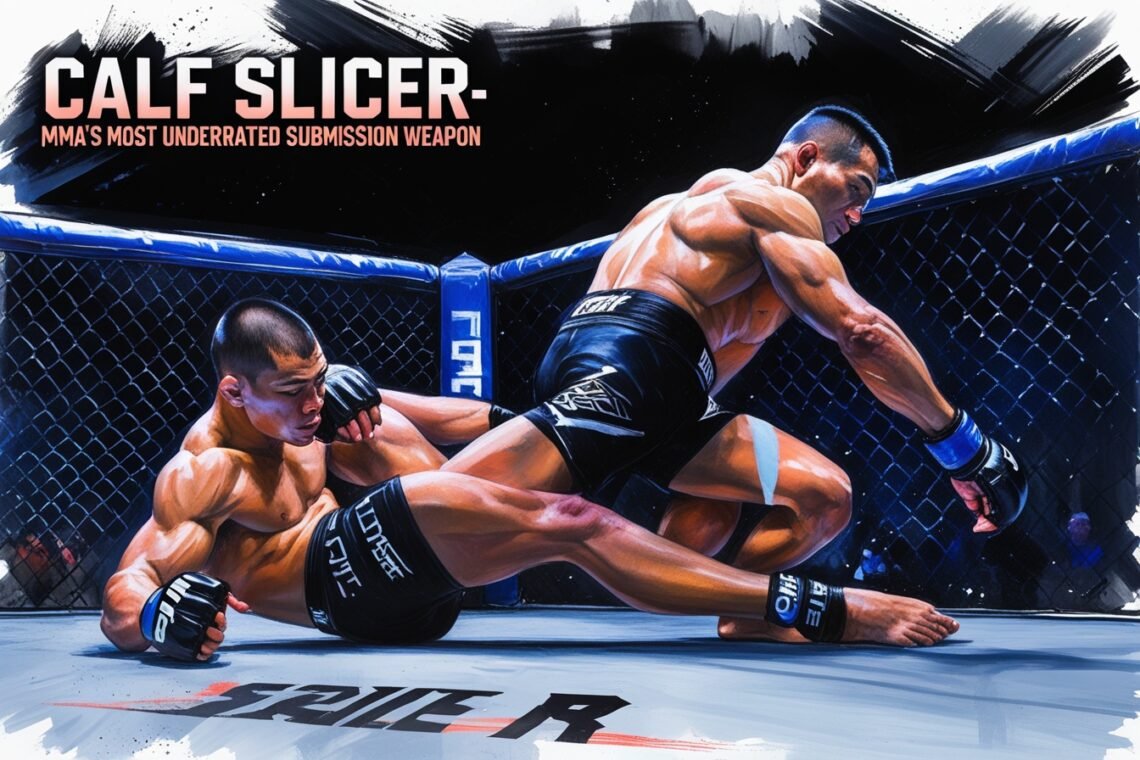
Under the pressure of inches, a tiny blade of bone can become a battlefield. That’s the hidden terror of the Calf Slicer, a submission weapon so excruciating it can force even elite fighters to tap in seconds. Often overshadowed by flashy chokes and armbars, this compression lock thrives in quiet setups and sudden reversals. Today, we pull back the curtain on why the calf slicer stands as MMA’s most underrated tool for ending fights.
The Science Behind the Calf Slicer:
At its core, the Calf Slicer is a biomechanical marvel. By wedging your shin or forearm against an opponent’s calf and driving their heel toward their hamstring, you create a crushing force that targets muscle fibers and stresses knee ligaments simultaneously. Unlike a heel hook that torques the joint, this compression lock delivers pain by compressing soft tissue against bone, think of a vice pressing flesh into steel.
In MMA, where every joint, tendon, and muscle counts, this technique exploits the vulnerability between the calf muscle and shin bone, often resulting in instantaneous submission. Its effectiveness in Brazilian Jiu-Jitsu schools, from Gracie academies to modern no-gi gyms, has grown as athletes learn to blend finesse with brute anatomy, making the calf slicer a quiet revolution in leg entrapment.
Crafting Unexpected Calf Slicer Setups:
The deadliest calf slicers come out of nowhere. Imagine you’re in half guard, pressuring an opponent’s hips, suddenly you slip your knee to their outer thigh, frame across their waist, then hook the calf under your shin. A subtle shift in hip angle and their leg is trapped. Or picture a turtle position scramble: instead of chasing the back, you spin underneath, slide your elbow behind the trapped knee, and hammer their heel inward.
Because it doesn’t demand full leg entanglement, you can spring the calf slicer from evolving transitions, guard passes, scrambles, even standing clinch exchanges. This adaptability makes it a prime submission weapon for fighters who weave old-school BJJ into modern MMA strategy.
The Agony Induced by Compression Locks:
Pain is the currency of compliance, and the calf slicer trades heavily in it. Victims describe a sensation like having their calf “folded” between two hard surfaces, sending shockwaves up to the knee and hip. Unlike joint locks that risk ligament tearing, compression locks can inflict muscle tears and bruising that linger for weeks.
This agony often triggers an immediate tap, no time for defensive wizardry. Because the technique targets flesh rather than bone or ligaments alone, even small adjustments in shin placement can amplify discomfort. When executed properly, the compression lock can turn a prolonged grappling exchange into a one-move finish, cementing its place as an underappreciated pain engine on the mats and in the cage.
Legendary Calf Slicer Moments in MMA History:
Though rare, the calf slicer has rocked big stages. In 2021, Charles Oliveira stunned fans with a calf slicer finish that snapped a contender’s leg, and the internet couldn’t stop talking. BJJ phenom Mikey Musumeci, in ADCC and superfights, has showcased the move’s potential, blending high-level leg entrapment into his sleek jiu-jitsu arsenal.
Even early pioneers like John Danaher have championed compression locks in grappling seminars, priming a new generation of MMA fighters to carry the torch. Each highlight reel reminds us: when the calf slicer lands, the crowd goes silent, awed by the sheer novelty and brutality of a well-placed leg lock.
Navigating Leg Lock Legality Across Disciplines:
One reason the calf slicer remains underrated is its complicated rule landscape. In IBJJF tournaments, most lower belts can’t use compression locks; it’s reserved for brown and black belts. ADCC embraces it fully, rewarding innovative leg attacks. In MMA, promotions generally allow calf slicers under unified rules, but many fighters still shy away, fearing that illegal angles or referee stoppage loom large.
This patchwork of legality means athletes must be well-versed in each organization’s specifics: knowing when to slip the shin, how far to drive the heel, and when to release pressure. Mastery of the rulebook becomes as crucial as technical prowess, adding another layer to its strategic allure.
Defensive Maneuvers to Dodge the Calf Cutter:
Avoiding the calf slicer demands hip mobility and sharp awareness. First, maintain a wide base: splaying your knees and keeping your elbows tight prevents shin insertion. When you sense the trap, align your leg straight up, this removes the angle the attacker needs to compress flesh.
Hand-fighting at the start can derail their setup; peeling grips off your foot delays the final lock. Rolling toward the trapped leg often dislodges the blade of the shin, opening space to slip free. Conversely, creating frames with your forearm against their thigh can break leverage. Drilling these escapes strengthens not only your defense but also teaches you to spot calf slicer cues before they become irreversible.
Drills to Integrate Calf Slicers into Your Repertoire:
To make the calf slicer a dependable go-to, start with slow-motion flow drills. From half guard or turtle, practice knee slides and shin alignments without applying full force, focus on hip positioning, and grip transitions. Next, add resistance: partner uses light defense while you refine the angle, exploring slight variations in foot placement to maximize compression. Supplement with mobility work: hamstring and calf stretches increase comfort in tight positions.
Film your sessions to catch incorrect shin angles or grip lapses. Finally, integrate the move into positional sparring: allow your opponent to resist leg attacks, forcing you to chain calf slicers with sweeps and escapes. Over time, what feels exotic becomes second nature, a hidden weapon ready for any MMA or BJJ battleground.
Conclusion:
The Calf Slicer may slip under the radar in a world obsessed with chokes and arm locks, but its blend of anatomical precision and shock-inducing pain makes it a game changer. By mastering both attack and defense, fighters gain a stealthy edge, one that can turn the tides of a match in a single wrench of the heel. As more athletes embrace its nuanced mechanics, the calf slicer’s moment in the spotlight is just beginning.
FAQs:
1. What exactly is a Calf Slicer?
A compression lock targeting the calf, where your shin or forearm crushes muscle against bone to force submission.
2. Why is the calf slicer underrated in MMA?
Its rarity and complex setups keep it hidden, while more common chokes steal the spotlight.
3. Can I use the calf slicer in all BJJ tournaments?
Most IBJJF events restrict it to brown/black belts, but ADCC and MMA promotions typically allow it.
4. Who popularized the calf slicer in high-level competition?
Fighters like Charles Oliveira and grapplers trained by John Danaher brought it to mainstream attention.
5. How do I defend against a calf slicer setup?
Maintain a straight leg, hand-fight grips, create frames with elbows, and roll toward the pressure.
6. What’s the best way to drill calf slicers safely?
Use slow-flow positional drills, light resistance, and mobility exercises before full-force sparring.